A few summers ago, I was onsite with a department on summer registration morning. I sat beside the summer programs team while the phones started ringing off the hook. Parents were asking about the waitlist, which classes were right for a seven-year-old who'd never swum before, and who just wanted someone to point them in the right direction.
Zooming out, I’ve spent the last three years sitting alongside recreation staff, doing many versions of that same morning. Helping check people in at the front desk. Sitting alongside program coordinators on the busiest day of their year. Watching facility managers schedule rec league field times and issue permits to the farmer’s market.
What has surprised me most is how much repetition there is. These recreation pros are incredibly accomplished – overseeing multi-million dollar budgets, navigating government policies and local laws, and managing a multitude of personalities – yet they spend so much of their days on tedious, repetitive tasks, like pulling the same cancellation report, downloading the same roster, or sending the same message to the same instructor, week after week. So the question is why?
Staff aren't doing repetitive work out of habit, or for lack of wanting change. They're doing it because the software they’ve been handed gives them no choice. Which raises a harder question: This industry isn't small, and this problem isn't hidden. So why isn't there a better way?
The magic is in workflows, not individual features.
At Rec, I lead our product and design team. My team’s role is to deeply understand the jobs to be done and build technology that makes them easier. One of our first realizations was that a single trigger event never resulted in simply one task.
When it rains, that one event breaks down into six tasks: cancel today's sessions, work out the reschedules, notify every registered household, notify the instructors, coordinate with those instructors on what happens next, and then answer the phone all afternoon. Six tasks, six different micro-workflows, and often one person holding the thread between them.
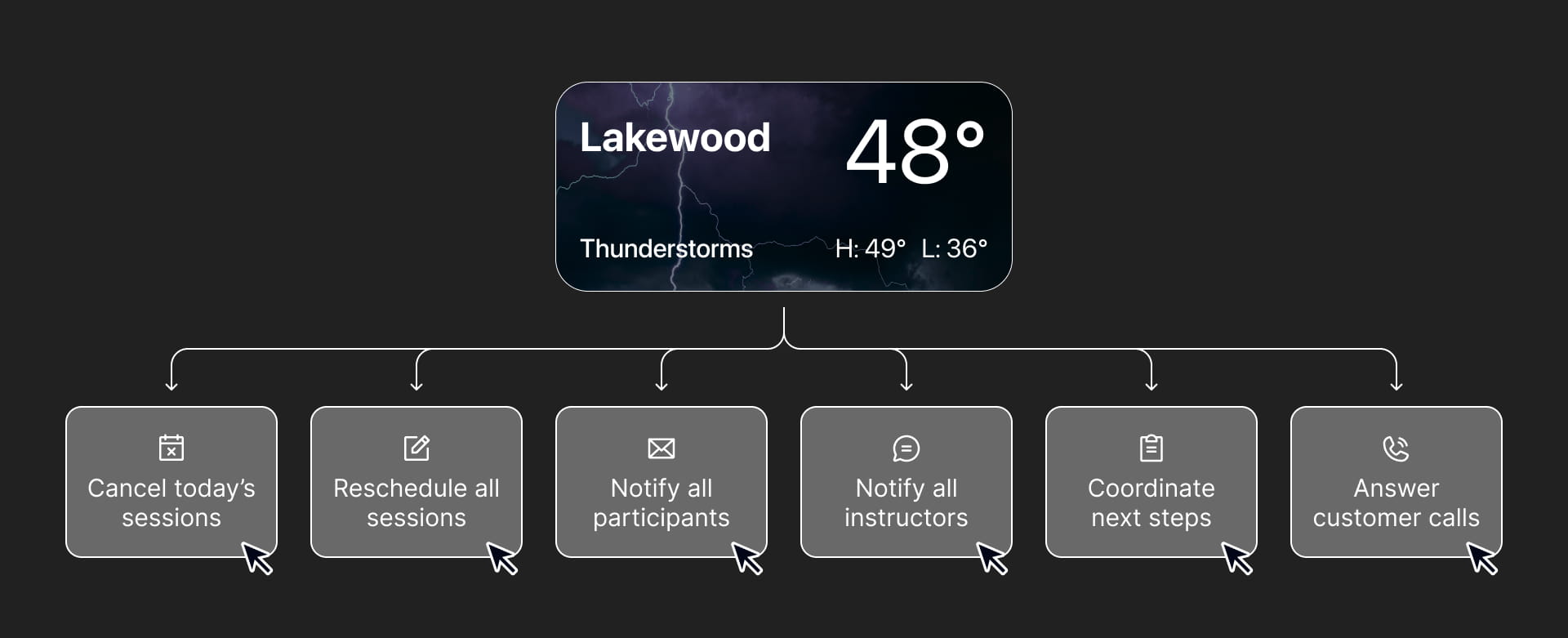
In traditional software development, we’d build an SMS broadcast feature to let admins send a notification when it rained, and then hope someone uses it when it rains.
Now, AI has fundamentally changed how we solve these problems and the quality of solutions we can deliver for our customers. We can now take any trigger and thread together the right steps at the moment. Moreover, AI learns from every past workflow, getting better as it gains context. That's what we want for recreation providers. Not a single step done faster, but a smarter, more capable solution that fundamentally changes what your team can deliver to your community.
In all, my team has cataloged more than 300 different workflows in a typical recreation agency. Together, they bring to life the parks and programs we love, and my team believes AI can support so many of them.
Our evolution
Last year, we started trialing our first agentic workflows with our refund and residency agents. However, we were still constrained by AI’s capabilities at the time, and had to pre-determine many parts of the workflow. Over the course of 2025, LLMs took a major leap forward – making it possible to reliably use AI to develop open-ended, on-the-fly solutions for customers. In industries like law and IT, we see AI taking over large swaths of repetitive tasks, in ways that feel bespoke to each firm.
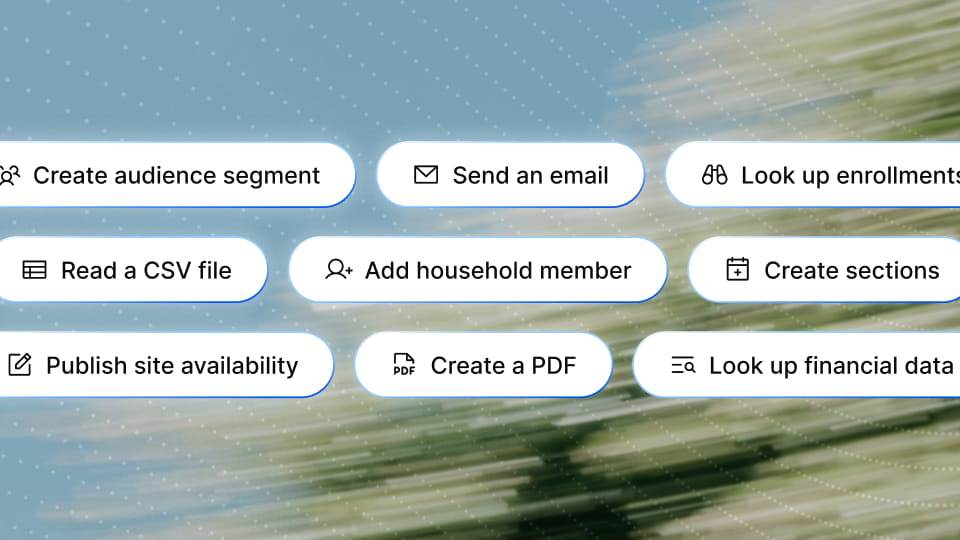
At Rec, we launched the Rec MCP, letting our internal Customer Experience team use AI to build complex solutions for customers. It was incredible. Work that had been manual and tedious — like a custom multi-hour data transfer — could suddenly be done in minutes. We kept expanding the toolkit, making more actions available and watched our team innovate more. The team started piecing together their own “custom software” for each client, using AI tools to build Rec workflows end-to-end.
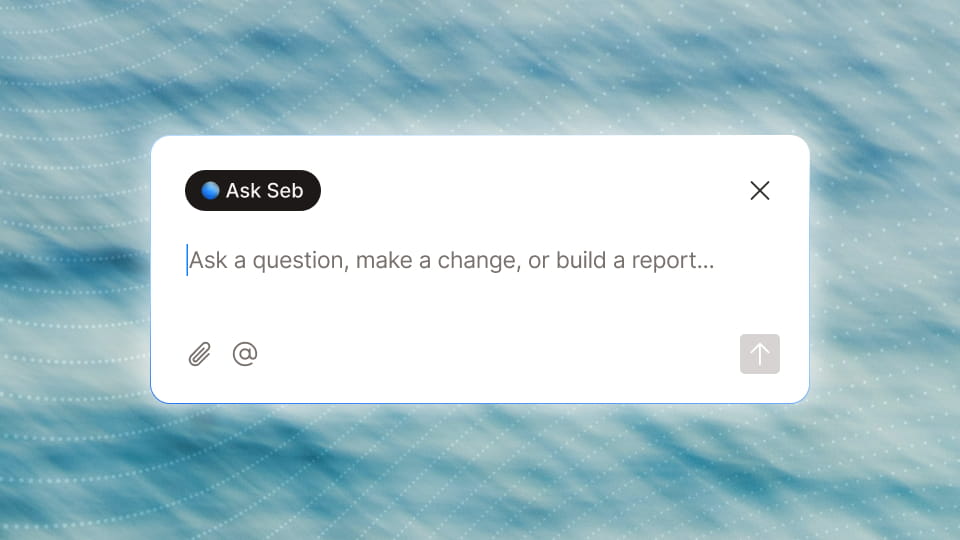
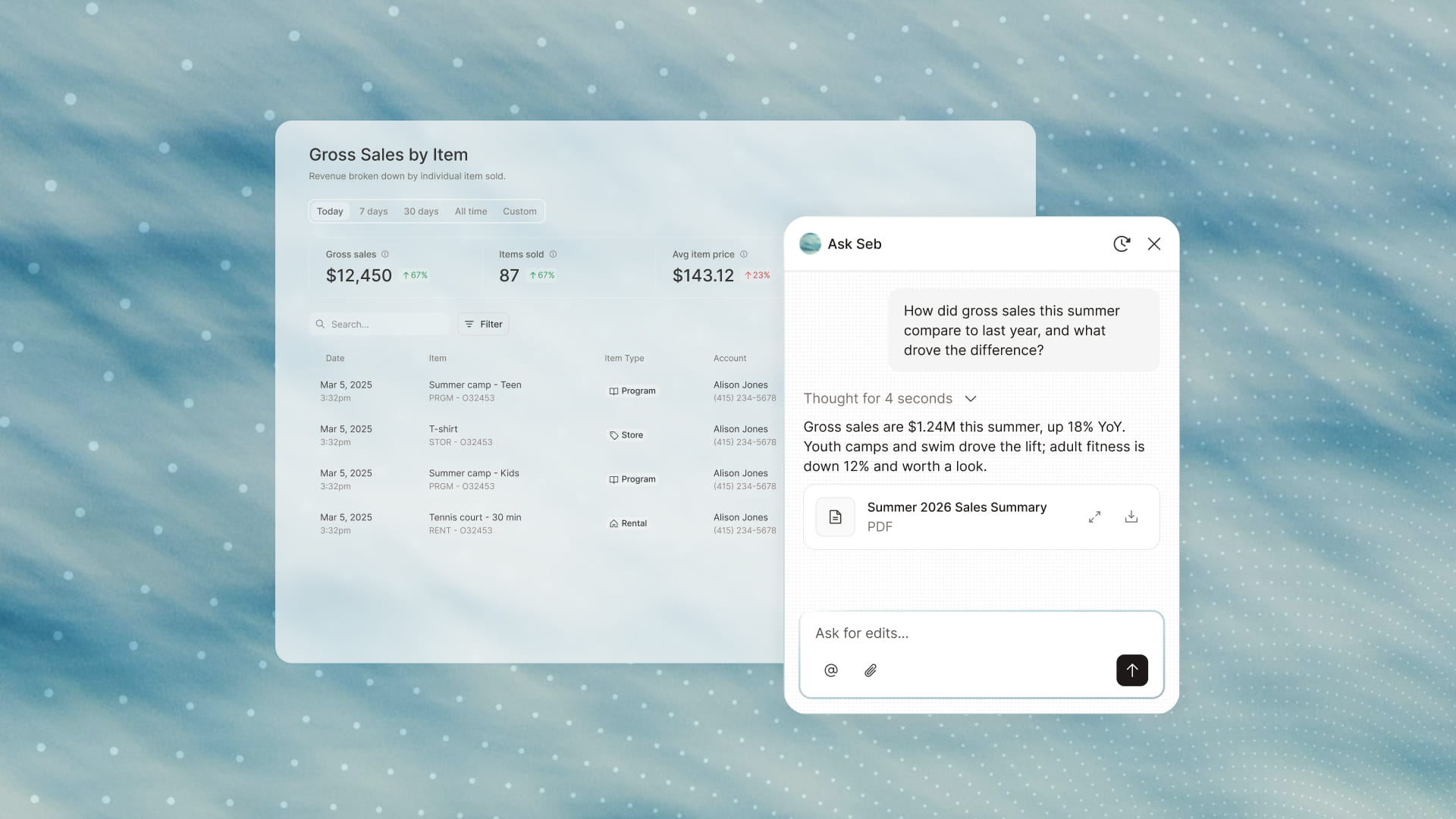
Inspired by the new found capability of our internal team, we quickly realized this could be a whole new paradigm for recreation operators globally. Our customers deserved a way to harness the superpowers we were feeling internally. So we started building Seb.
AI purpose-built for recreation
Ask any rec department, "what's the price?" and there is no simple answer. One item carries a resident rate and a non-resident rate, a youth rate or a senior rate, sibling discounts, promotions, and more.
Ask a department, "what's the utilization of this facility?" and it's just as tangled. On the surface, a site is a reservable space. Underneath, those spaces overlap physically. Two pickleball courts sit on top of a tennis court. When someone books the pickleball courts, the tennis court becomes unavailable — but it isn't reserved. It's blocked. If you don't understand the difference between a primary use and a secondary block, your utilization report is wrong.
You can't get that understanding from a general-purpose AI model alone. Seb needs context on how this industry works, the lingo professionals use, and how to interpret the data model, and the playbook for the actions it can take.
Our applied AI team sits alongside the rest of our product and engineering team at Rec. Their job is to take the knowledge gained from years of building recreation workflows, processing bookings, and interacting with customers and using that to build AI tools specifically tuned for rec professionals.
Seb is built directly into Rec
This is where we part ways with most of what I see being built in this industry. Most AI features sit on top of software and read from it. We most often see chatbots that have access to limited information or will eventually provide a little guidance, but inevitably, 90% of those use cases still end up with work for your staff. We're not out to save a few minutes. We want to save hours, fully resolve that issue and leave customers delighted with their experience. Which is why we designed Seb to feel like an empowered member of your team that is trained with skills, has access to tools, and can be assigned work.
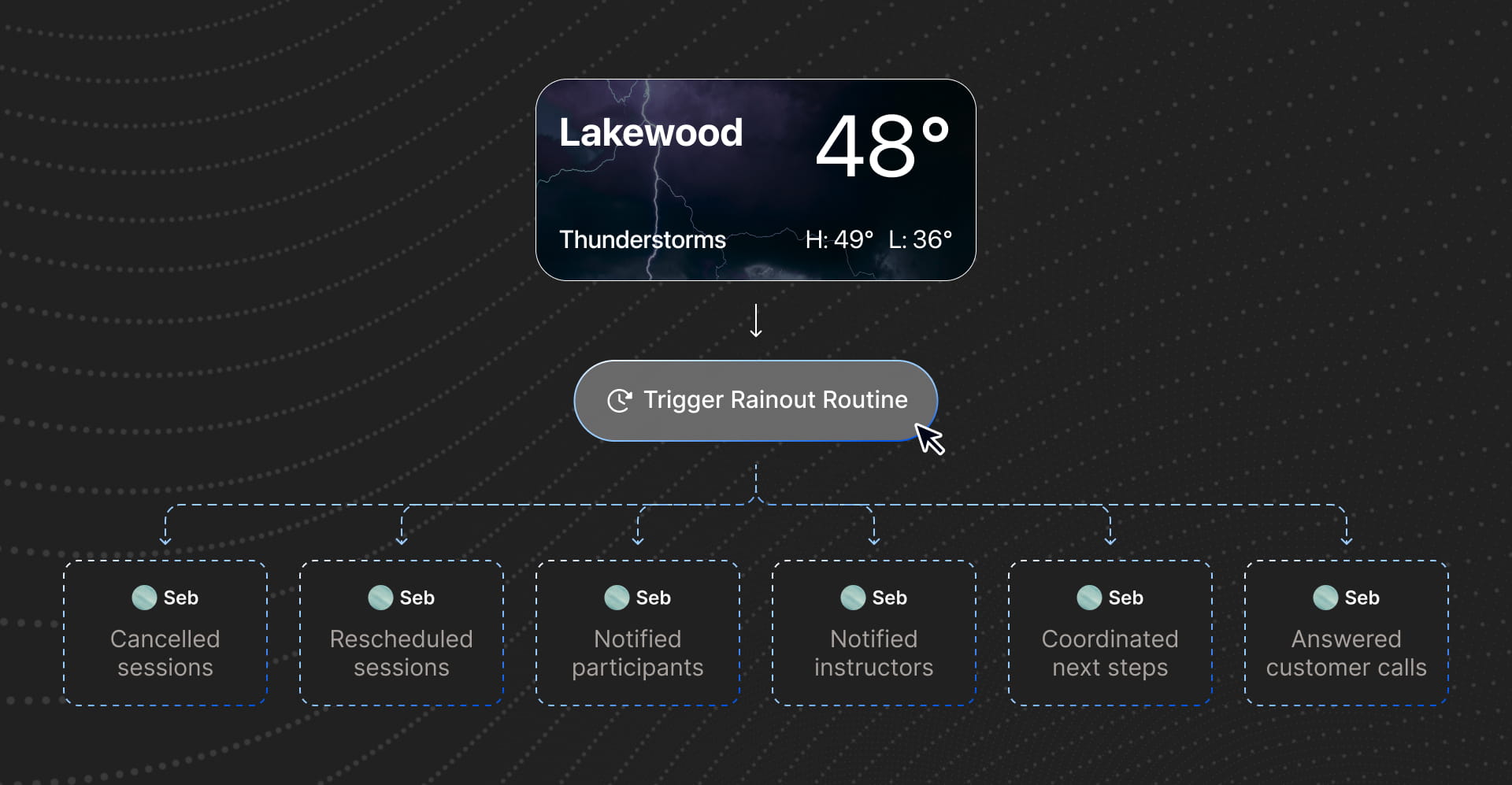
Which brings us back to that inevitable rainout. When Seb figures out it's going to rain tomorrow afternoon, Seb already has the programs, rosters, instructors, contact information, and the tools to reach participants and proactively reschedule their sessions.
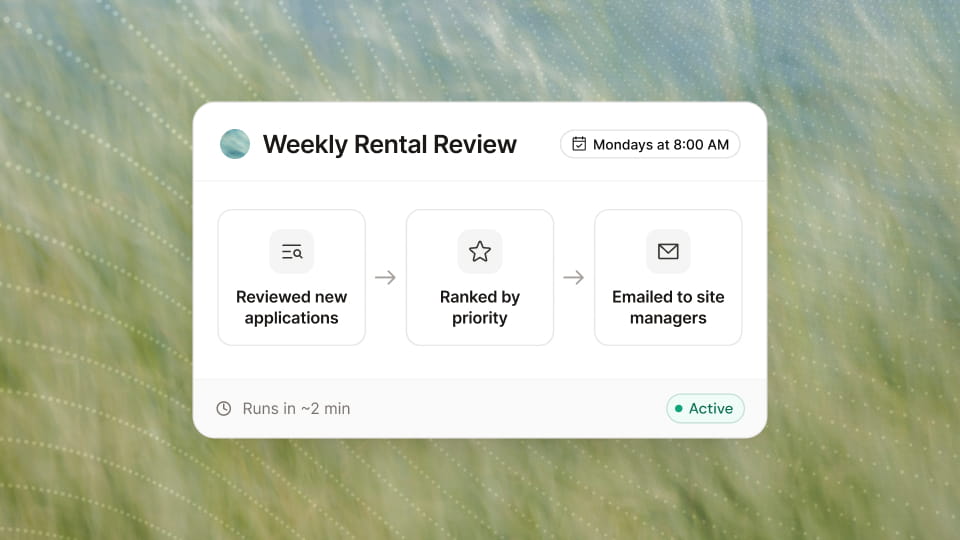
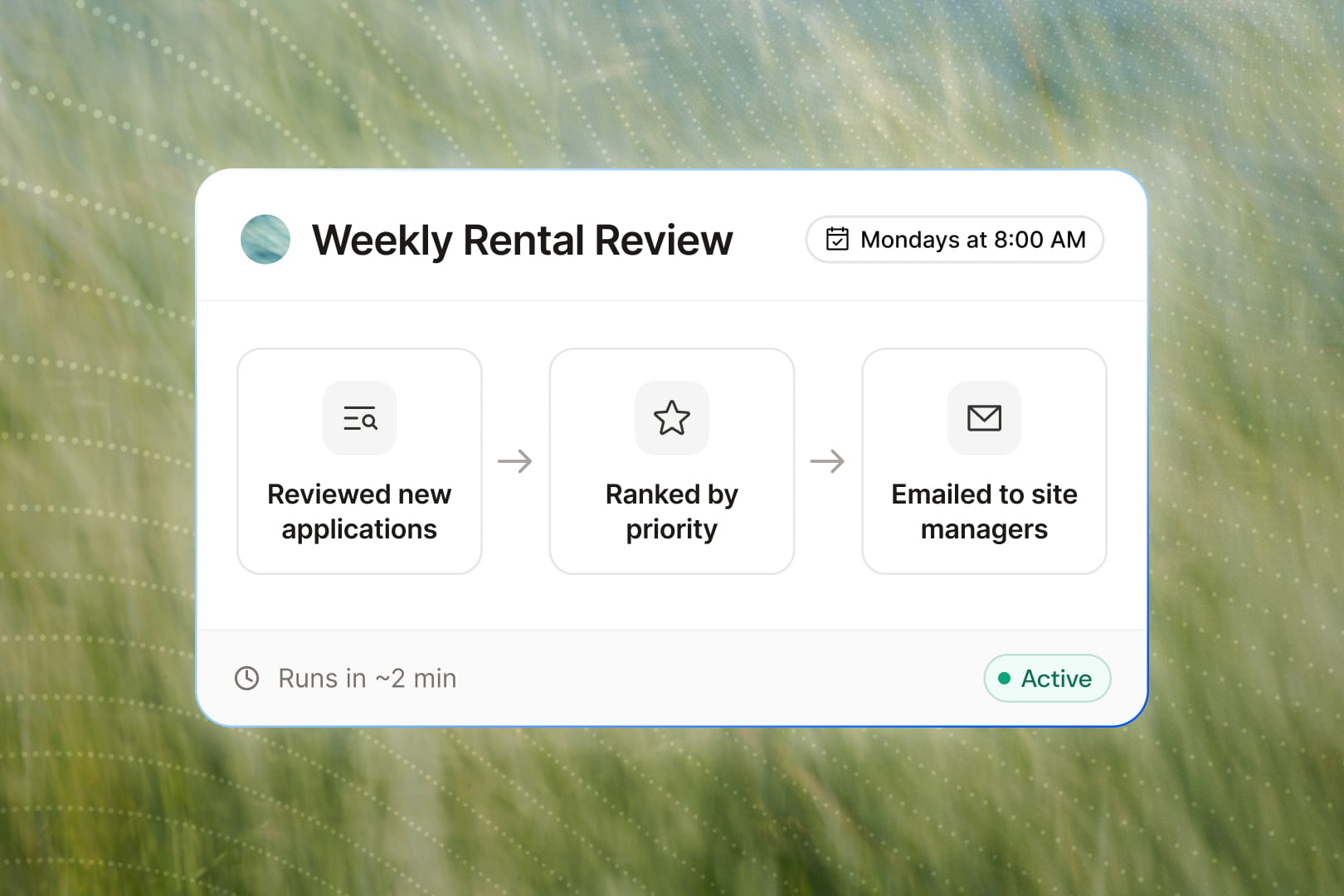
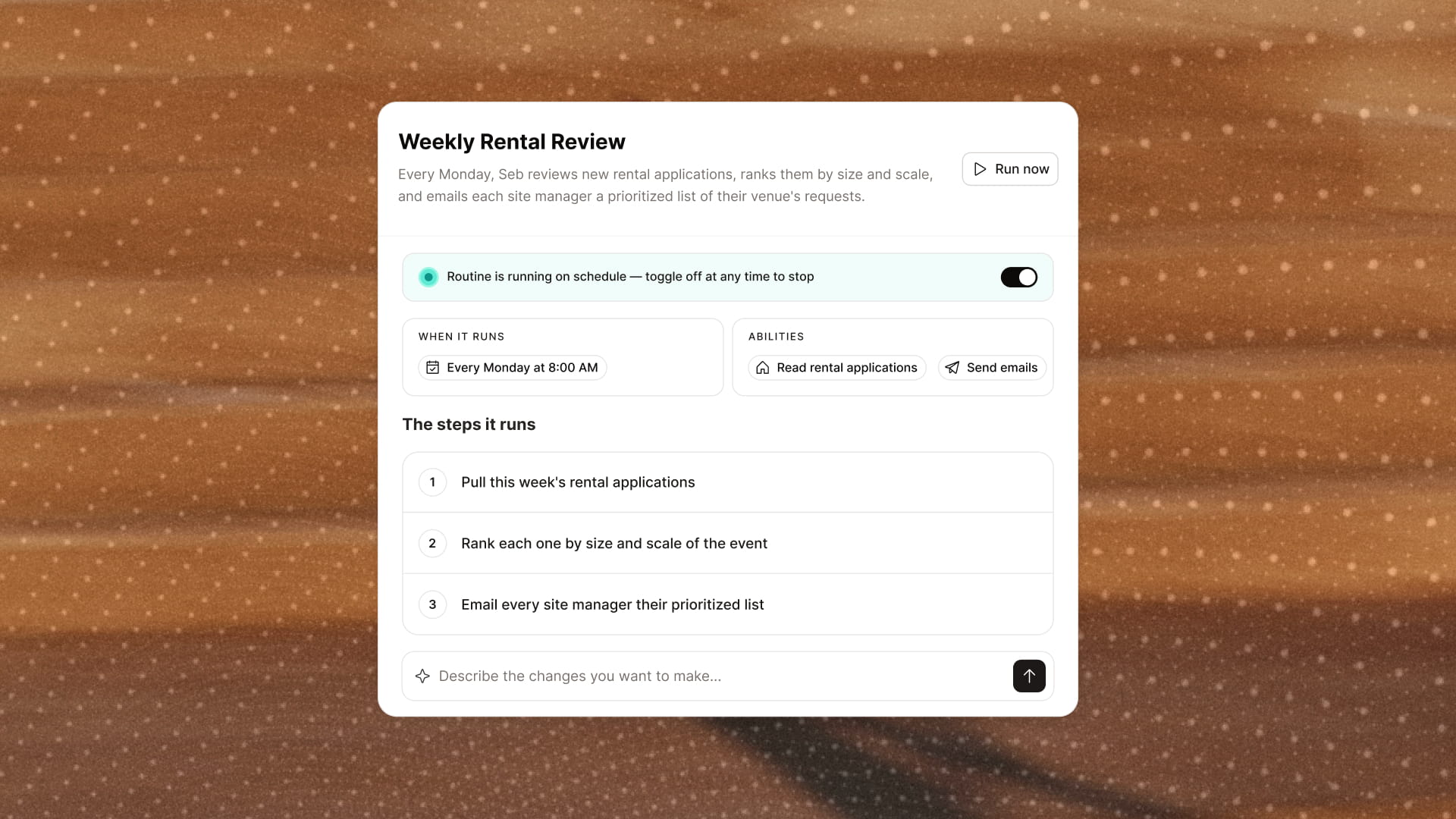
Seb can also run on a schedule. That report you pull every Monday, that reminder you send out every week — just ask Seb. It also works off events, too. You already get a notification when a rental application comes in; now Seb gets one as well. You tell it what to review the application for, and what you want it to do next, and it’ll take the initial review of every application off your plate.
Seb has the skills to use the same primitives the rest of the platform uses. That means it can do the work, not just describe it. Over the coming year, Seb will continue to gain capabilities, get smarter, and become a more and more helpful teammate to your team.
Building with our community
When we started testing Seb with our first few partners, we were blown away by the reception. We often build features alongside partners, but something about Seb was different. People were so excited and had so many questions that we realized our usual way of building wouldn't keep up. So we launched the Seb community, a forum where our early partners talk directly with our product, engineering and design teams. The engagement has been incredible. Partners aren't just pushing Seb to new heights — they're sharing ideas, prompts and routines with each other.
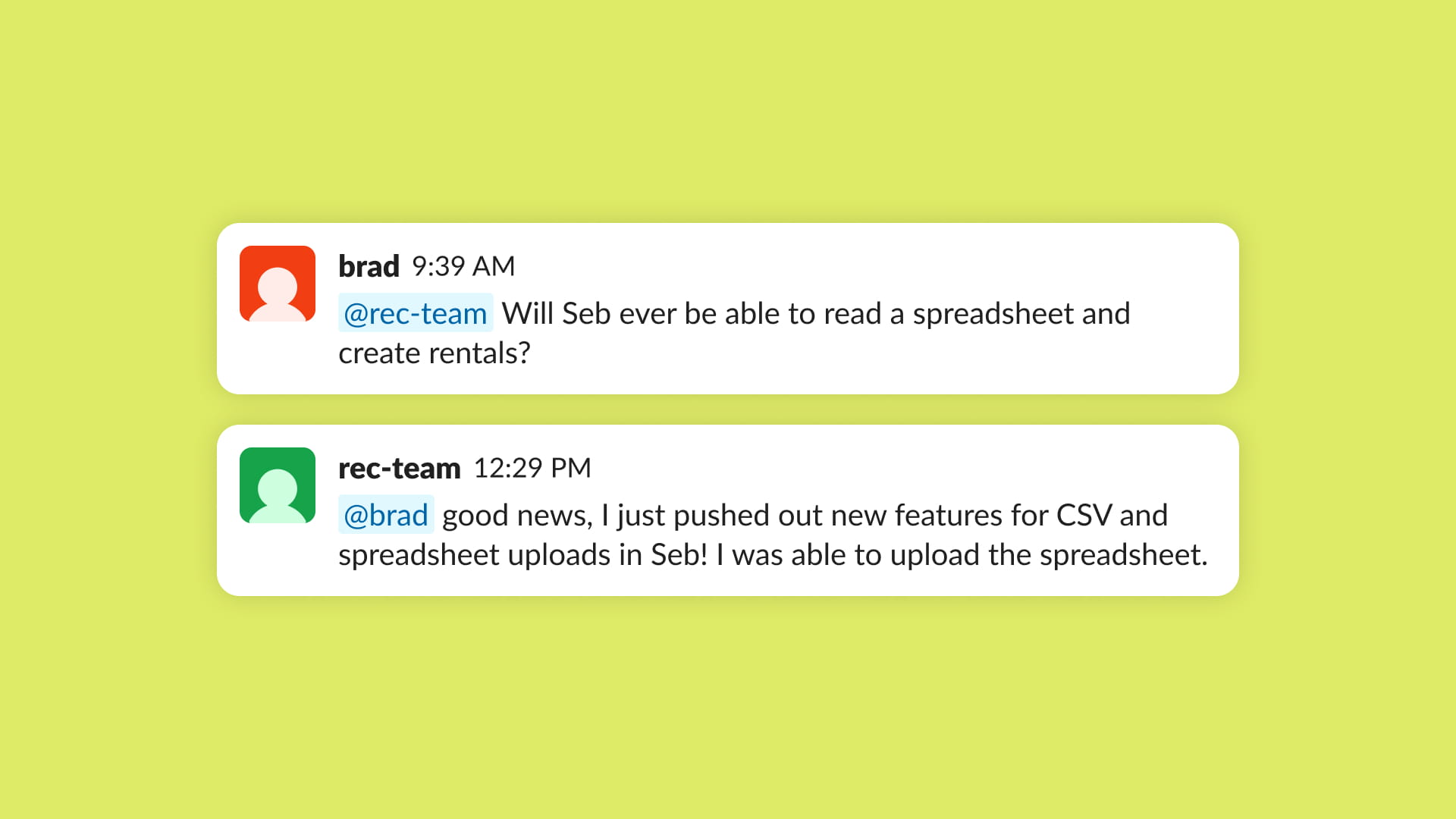
Have you ever had a reservation schedule so complicated it lived in a spreadsheet before it ever made it into the system? So has Brad and his team at Apex. Brad had the idea to upload that spreadsheet to Seb and have Seb translate the schedule, break it down, and create the rental. When he proposed it, our team built it.
I'm so proud to say Seb is truly being built by rec professionals, for rec professionals.
This is just the beginning
We started with rec departments because they're the connective tissue underlying the whole equation. But we're excited to explore what Seb can do for the other parts of the industry. Can Seb match students to instructors? Can it take the admin burden off our facilitators? Can it help parents prep for summer registration? Maybe even stand in line on their behalf, and make that morning a little less stressful?
We're dreaming about all of it here at Rec.
I'm excited for all our Rec customers to start using Seb in the coming weeks, and I can't wait to share more soon.